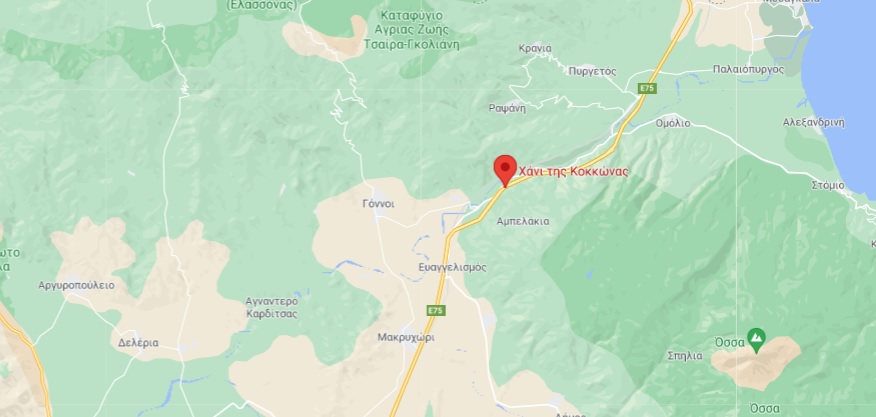


Hani tis Kokkonas
The Tempi Valley, which is one of the most impressive landscapes in Greece, with unparalleled natural beauty, it is the most important trade route from Thessaly to Macedonia. On one hand, you see the imposing Olympus Mountain, the residence of gods and heroes and on the other hand, you see Kissavos, "the mountain of cells". In the middle of two mountains, you can see Pinios River. Furthermore, there is the Hellenistic & Byzantine complex at the site of the road, which is called "Hani tis Kokkonas". During the construction of the new road, there had been conducted excavations by the Greek Cultural Ministry at the western entrance of the Tempi valley. It has built in the 19th century and it was founded in 2008-2013, under the scientific responsibility of archaeologists Mr. George Toufexis and Mr. Stavroula Sdrolia. In recent years, great archaeological finds have been found at the site of the road that testifies to architectural remains both of Hellenistic and byzantine complex. There is a cult and laboratory character, both of a Byzantine temple and a Byzantine building which was characterized as an inn, since the years 2016-17. Archaeological information confirms the existence of the ancient city of Omolio near the present village, at the eastern end of the valley, where it was found part of a burial cemetery of the archaic period and box-shaped tombs of the classical era.
In its northernmost part, there was discovered the Macedonian city of Fila, today's Kato Aigani, at its northeastern exit is the sanctuary of Apollo, while at its western end is the city of Gonni. If you go a little further west, you will find the tomb of Hassan Baba, an Ottoman house of gatherings and pilgrimages of the 15th century. In the center of the valley there is the famous church of Saint Paraskevi, a timeless place of worship for the faithful and is one of the most important pilgrimages in the prefecture of Larissa with thousands of visitors each year. The famous church was built around 1910. Archaeological finds and "Kybela, mother of gods", which this Hellenistic complex had many rooms. In the southern part of the worship there was announced the mother of gods, the goddess of fruitfulness and fertility-Kyveli. The widespread deity in Thessaly is a part of a marble temple-shaped column with the embossed form of the throne and a small lion on its knees and various ritual utensils that refers to the performance of sacrifices. An important part of the inscription ONETHEIKE, which probably belongs to the goddess Artemis and a clay tile with a bust of the same goddess, testifies to the gathering of two deities, which are related to the rich, wild land and the vegetation in the Thessaly plain. .
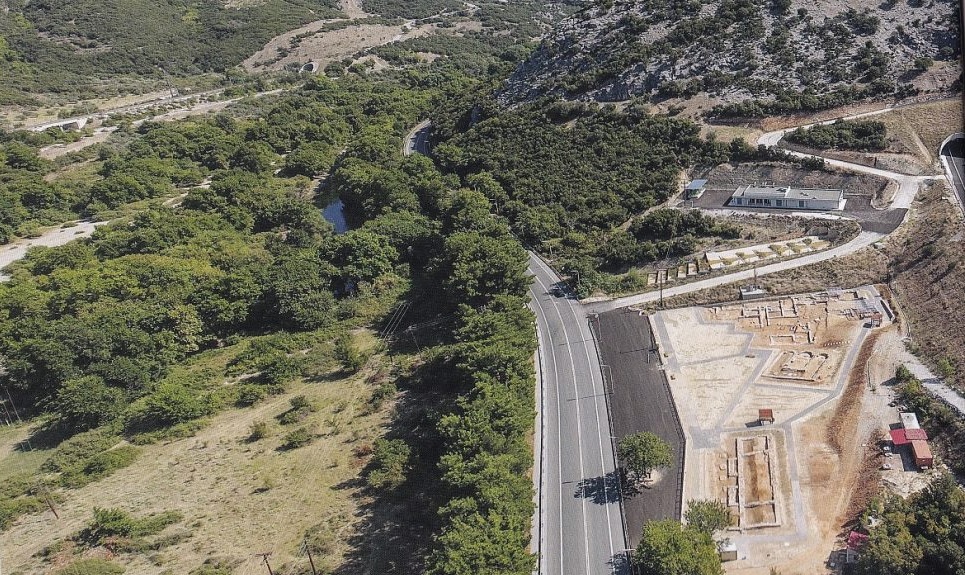
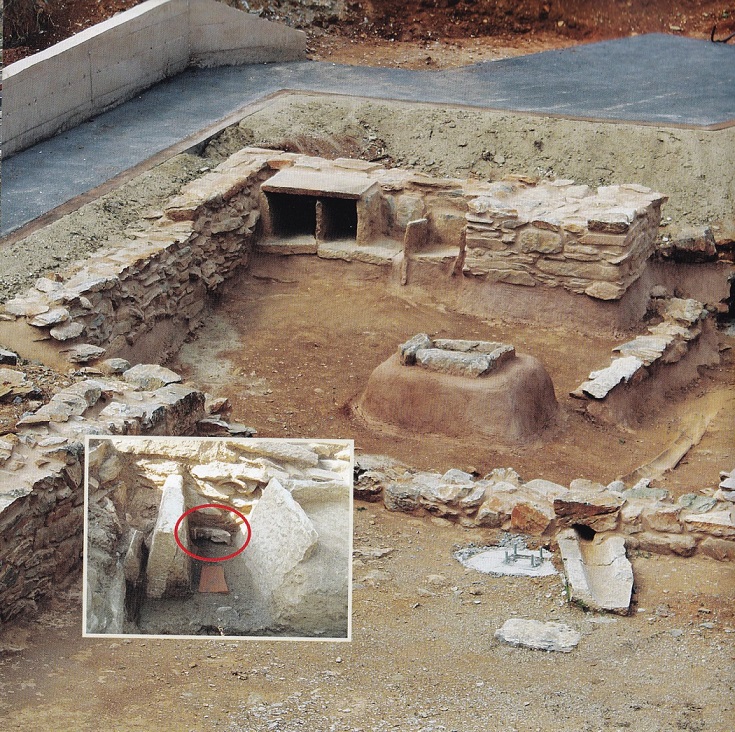
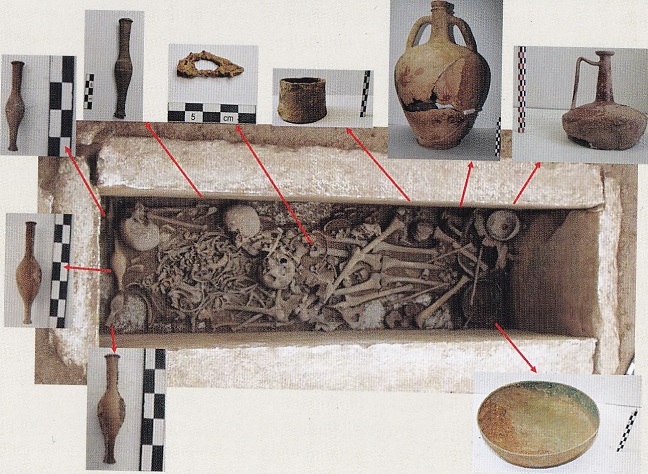
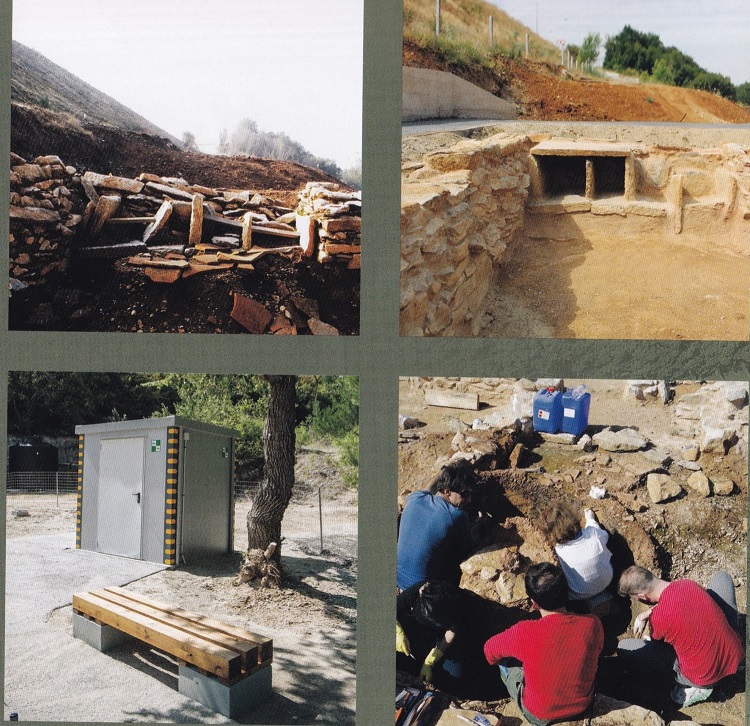
Suddenly, there was also a light in the tunnel after a number of archaeological excavations such as: iron chisels, needles, workshops directly related to the operation of ancient and Byzantine marble quarry, ceramics, bronze (mainly from Macedonian and Thessaly mints) and silver coins with bullfighters from Triki of the 5th c. BC, metal, bone and glass objects, clay jars, stone columns, tile (variant of the game Five Letters), ten tombs of the late classical, Hellenistic and Roman periods. At the same time, the complex served the needs of passers-by for food, rest and accommodation. Three Byzantine complexes, archeological relics of the early Christian period belonging to the Justinian era, rectangular linen, ceramic kiln, circular lime kiln, with the last three antiquities being in line with the course of the new road . Coins of Basil I, that were found under the floor, an inn of Byzantine times in an elongated shape built on the site of a Roman station, ruins of a Byzantine temple, traces of two banks of the Holy Step, excavations of 49 tombs and a cemetery with organization and duration are some of the findings that are now familiar with the Archaeological department. It is noteworthy that in the area of Tempi had been established the seat of the diocese of Lykostomi or “Thettalian” Tempi which is announced by the Byzantine sources in the 10th c. that it belongs to the Diocese of Thessaloniki. Then, it is transferred to Platamonas, the post-Byzantine period in Ambelakia until its final integration in the Diocese of Larissa. The sacred character of the above has been "moved" today to the pilgrimage of Saint Paraskevi. The studies were carried out by the architect, Dimitris Koutsogiannis in 2013 and refer to the shaping, promotion, fixing, maintenance and restoration of monuments in the area of Tempi, while the work was done in the context of the construction of the tunnels of the new national road Tempi-Thessaloniki. Today, the purpose of the preservation of the archeological site is initially the protection of the monuments with metal fencing on the old national road, where inside it is a construction corridor. This was built by wooden kiosks, information signs were placed and later they made the cultural upgrade of the area.